
Construction Schedule Checklist: What Should It Include?
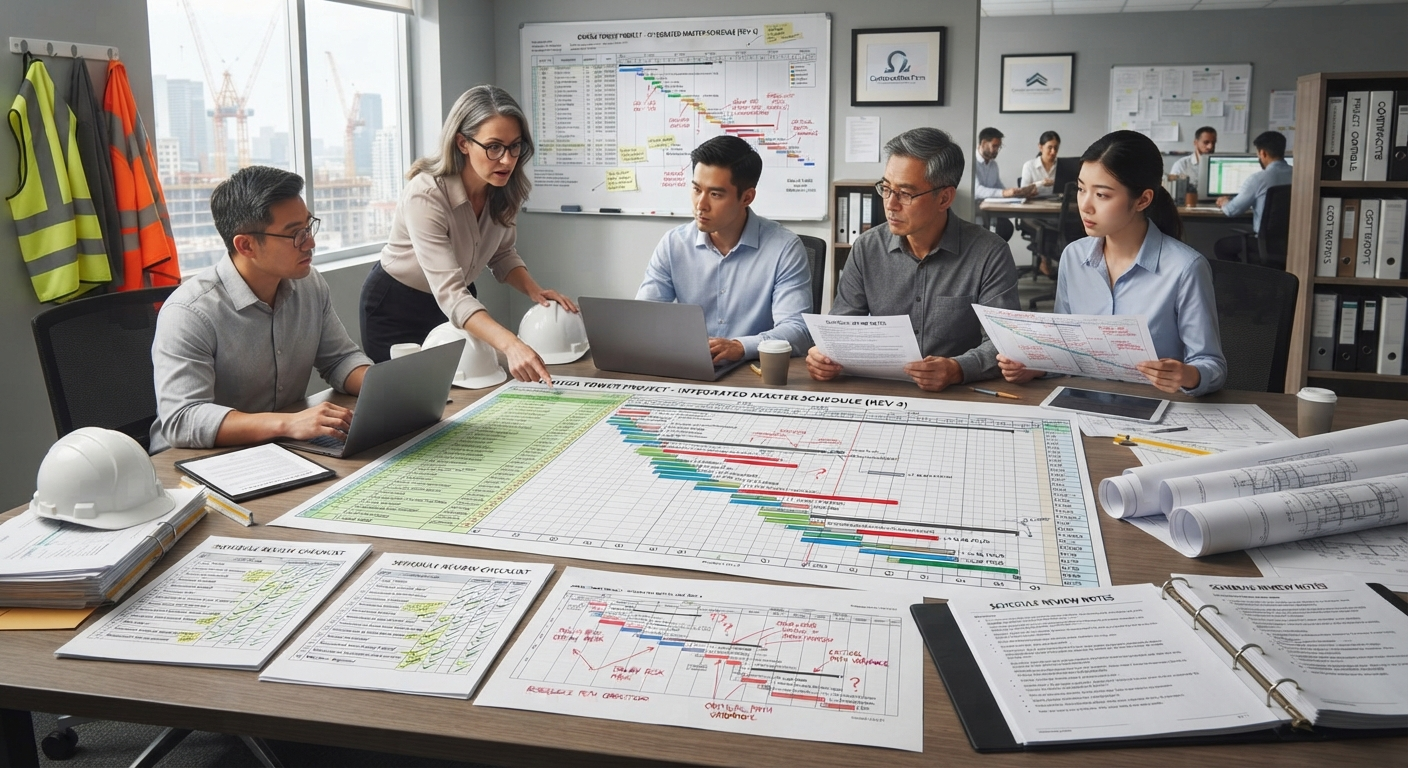
A Construction Schedule checklist helps contractors and project managers verify that every essential activity, milestone, resource, and deadline is included in a project timeline. It also helps identify missing tasks, scheduling gaps, and potential delays before construction begins.
For professional project planning and timeline development, Engineering Geni provides construction scheduling services for contractors, builders, and construction teams across the USA.
This guide covers what a Construction Schedule checklist should include, from work breakdown structures and activity dependencies to resource planning, critical paths, and project closeout.
What Should a Construction Schedule Checklist Include?
A construction schedule checklist should include the project scope, work breakdown structure (WBS), activities, estimated durations, start and finish dates, dependencies, milestones, labor and equipment requirements, procurement, inspections, and progress updates.
Here are the essential components:
- Project information and scope
- Work breakdown structure (WBS)
- Construction activities and task durations
- Activity dependencies and work sequence
- Project milestones and deadlines
- Labor, equipment, and material resources
- Permits, submittals, and inspections
- Critical path and schedule float
- Baseline schedule and approval
- Progress tracking and schedule updates
- Risk allowances and contingency planning
- Project closeout activities
Each component serves a different purpose, but all must work together to create a realistic project timeline.
1. Project Information and Scope
Before reviewing individual activities, confirm that the schedule accurately represents the project being delivered. A well-prepared Construction Schedule checklist helps project teams identify missing project information before scheduling begins.
Include the following details:
- Project name and location
- Owner or client information
- General contractor and project manager
- Contract award and notice-to-proceed dates
- Planned construction start date
- Contract completion date
- Project type and scope of work
- Contract requirements and key restrictions
- Approved drawings and specifications
The project scope is particularly important. A commercial building, residential development, and infrastructure project will have different activities, approval requirements, and construction sequences.
2. Work Breakdown Structure (WBS)
A work breakdown structure divides the overall project into smaller, manageable sections. It provides the organizational framework for identifying the work that must be completed and assigning responsibility for each part.
Without a proper WBS, activities can become too broad, making it difficult to estimate durations, allocate resources, and track progress.
A typical construction WBS may include:
| WBS Level | Work Category | Example Activities |
1 | Preconstruction | Planning, permits, submittals |
2 | Sitework | Clearing, grading, excavation |
3 | Foundations | Formwork, reinforcement, concrete |
4 | Structure | Columns, beams, slabs, framing |
| 5 | Building Envelope | Roofing, windows, exterior walls |
| 6 | MEP Systems | HVAC, plumbing, electrical |
| 7 | Interior Finishes | Drywall, flooring, painting |
| 8 | Closeout | Testing, inspections, punch list |
The level of detail should match the project’s size and complexity. A small residential project may need fewer breakdown levels than a hospital, industrial facility, or large commercial development.
Once the work breakdown structure is established, the next step is to connect individual activities, estimate their durations, and organize them into a logical project timeline. Our guide on how to create a construction schedule explains this process, from defining the project scope to establishing a baseline and tracking progress.
3. Construction Activities and Task Durations
Once the WBS is established, use the Construction Schedule checklist to verify that every work package includes the activities needed for completion.
Every activity should have a clear description, an estimated duration, and a defined place in the project sequence. Avoid vague entries such as “complete structure” when the work can be separated into measurable operations.
For example, structural construction may include:
- Install formwork
- Place reinforcing steel
- Complete concrete placement
- Allow concrete to cure as specified
- Remove formwork when permitted
- Complete structural inspections
Activity durations should reflect the actual quantity of work, crew productivity, working hours, equipment availability, site access, and construction conditions.
4. Activity Dependencies and Work Sequence
Construction activities rarely happen independently. Most tasks depend on the completion or progress of other activities.
Dependencies establish the logical relationships between activities and help determine when work can begin or finish.
The four common dependency relationships are:
- Finish-to-Start (FS): The successor activity begins after the predecessor finishes.
- Start-to-Start (SS): The successor begins after the predecessor starts.
- Finish-to-Finish (FF): The successor finishes after the predecessor finishes.
- Start-to-Finish (SF): The successor cannot finish until the predecessor starts.
Consider a typical foundation sequence. Excavation must reach the required stage before foundation formwork can proceed. Reinforcement and embedded items must be installed and inspected before concrete placement. Subsequent work depends on the concrete meeting the specified requirements.
Incorrect dependencies can create overlapping activities that are not physically possible or unnecessary gaps that extend the project timeline.
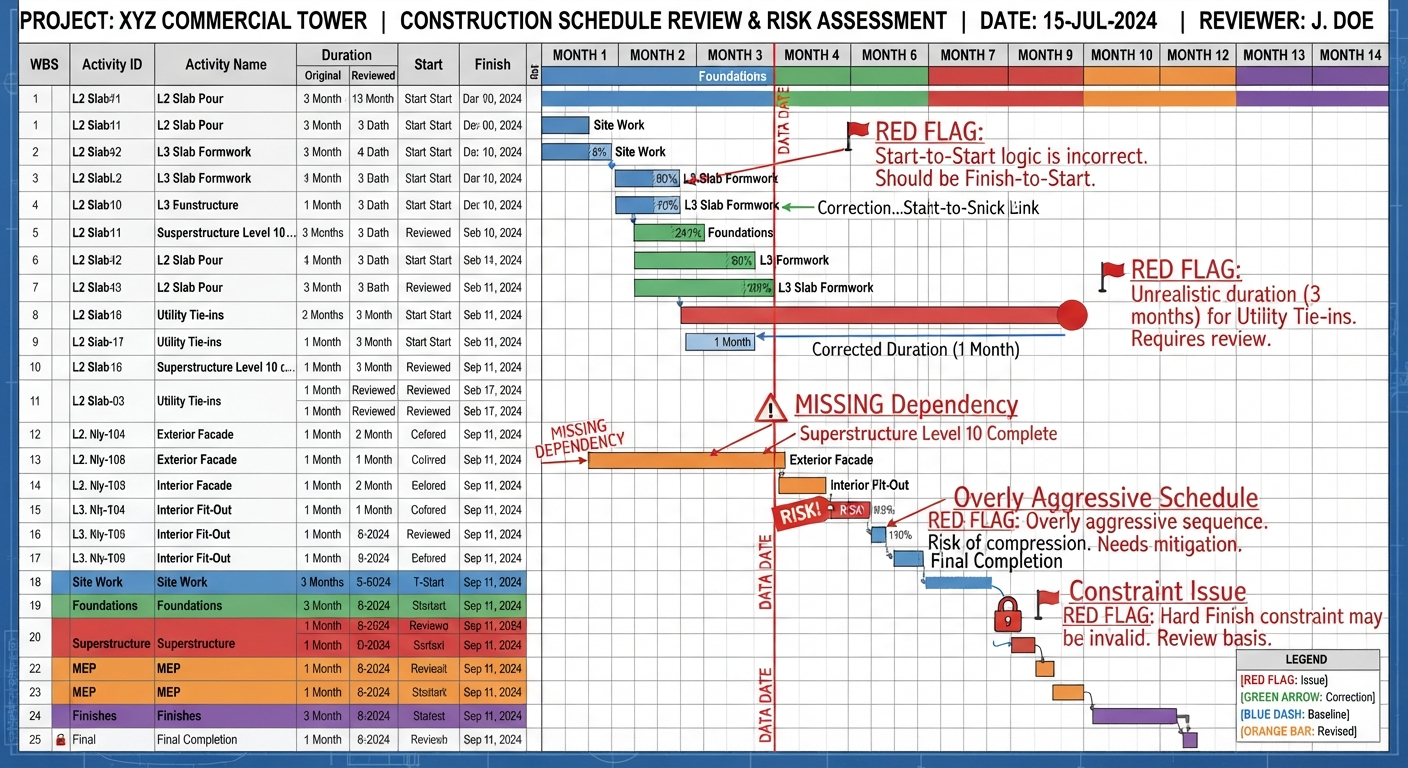
For a better understanding of construction sequencing, project managers should also understand What Is a CPM Schedule in Construction? A Critical Path Method schedule uses activity relationships and durations to identify the sequence of work that determines the project completion date.
5. Project Milestones and Deadlines
A Construction Schedule checklist should identify important milestones and completion points throughout the project. Unlike regular activities, they generally have zero duration and help the project team monitor significant contractual and operational dates.
Include relevant milestones such as:
- Notice to proceed
- Permit approval
- Site mobilization
- Foundation completion
- Structural framing completion
- Building dry-in
- MEP rough-in completion
- Substantial completion
- Final inspections
- Certificate of occupancy, where applicable
- Final acceptance and project handover
6. Labor, Equipment, and Material Resources
A Construction Schedule checklist should verify that the resources required for each activity are available at the right time.
Resource planning helps project managers identify potential shortages before they affect construction activities.
Include:
Labor requirements:
- Number of workers required for each activity
- Subcontractor responsibilities
- Crew availability
- Required skills and certifications
- Trade coordination requirements
Equipment requirements
- Cranes and lifting equipment
- Excavators and loaders
- Concrete pumps
- Scaffolding and temporary access equipment
- Specialized installation equipment
Material requirements
- Concrete and reinforcing steel
- Structural steel
- Lumber and framing materials
- HVAC equipment
- Electrical components
- Plumbing fixtures
- Doors, windows, and finishing materials
7. Permits, Submittals, and Inspections
A Construction Schedule checklist should also account for administrative and approval-related activities. They are not separate from construction planning because fieldwork often cannot proceed until the required approvals are obtained.
Depending on the project, include:
- Building permit applications and approvals
- Trade-specific permits
- Shop drawing preparation and review
- Material submittals
- Requests for information (RFIs)
- Structural inspections
- Electrical inspections
- Plumbing inspections
- Mechanical inspections
- Fire protection inspections
- Testing and commissioning approvals
8. Critical Path and Schedule Float
When reviewing a Construction Schedule checklist, verify that critical path activities and schedule float have been properly assessed. The critical path determines the earliest possible project completion date based on the schedule’s logic, durations, and constraints.
A delay to an activity on the critical path can delay the overall project unless corrective action is taken.
Schedule float, also called slack, represents the amount of time an activity can be delayed without affecting a specified completion date or successor milestone.
For example, if an activity has five days of total float, it can generally be delayed by up to five days before affecting the project completion date, assuming the schedule logic and other conditions remain unchanged.
Project managers should review:
- Activities on the critical path
- Near-critical activities
- Total float values
- Activities with unrealistic float
- Dependencies driving major deadlines
- Potential schedule impacts from delays
A critical path review should not be limited to looking at a software-generated report. The activity relationships and durations must also make sense in the field.
9. Baseline Schedule and Approval
A Construction Schedule checklist should verify that the baseline includes all required activities, realistic durations, dependencies, and contractual milestones before approval. A baseline schedule is the approved reference plan used to measure actual project progress against the original project timeline.
Before approval, review the following:
- All required activities are included.
- Activity durations are realistic.
- Dependencies reflect construction logic.
- Contractual milestones are correct.
- Resource and procurement requirements are considered.
- Permits and approval activities are included.
- The critical path is reasonable.
- Project calendars and working hours are accurate.
- The schedule aligns with contract documents.
Once accepted, the baseline should be maintained as the reference point for measuring performance. Approved changes should be documented through the applicable project procedures rather than silently changing the original plan.
The U.S. General Services Administration’s construction scheduling requirements provide useful guidance on construction contract schedules, including activity sequencing, progress reporting, and schedule management. Reviewing these requirements can help project teams understand the importance of maintaining an accurate and properly documented construction schedule.
10. Progress Tracking and Schedule Updates
A construction schedule checklist should be maintained throughout the project rather than treated as a document that is completed once and forgotten.
Regular updates allow project managers to compare planned progress with actual field performance and identify activities that require attention.
Each update should include:
- Actual activity start dates
- Actual activity completion dates
- Remaining activity durations
- Current percentage of completion
- Delayed or incomplete activities
- Revised forecast dates
- Changes in critical path
- Current float values
- Approved changes and their schedule impacts
Update frequency should follow the contract requirements and project management procedures. Some projects require weekly updates, while others use monthly reporting cycles.
For day-to-day coordination, a shorter planning window can also help supervisors identify upcoming work, material requirements, and trade conflicts.
A 6-Week Lookahead Schedule in Construction: What It Is and How It Works provides a more detailed view of near-term activities and helps teams coordinate work that is approaching.
11. Risk Allowances and Contingency Planning
A Construction Schedule checklist should account for unexpected conditions that may affect the project timeline. Material shortages, labor availability, design changes, and unforeseen site conditions can influence construction activities.
Consider the following risks that may affect the project’s timeline:
- Seasonal weather conditions and extreme temperatures
- Rain, snow, and severe weather restrictions
- Material procurement and delivery delays
- Subcontractor availability
- Utility connections and approvals
- Unforeseen underground conditions
- Design revisions and change orders
- Inspection and approval delays
- Site access and logistical restrictions
12. Project Closeout Activities
Construction work is not complete simply because the main building or structure is finished. The schedule must also account for testing, inspections, documentation, corrections, and final handover.
Closeout activities may include:
- System testing and commissioning
- Final building inspections
- Punch list preparation
- Deficiency corrections
- Final cleaning
- As-built drawings
- Operation and maintenance manuals
- Warranty documentation
- Final approvals
- Owner training
- Final acceptance and handover
Construction Schedule Checklist: Final Review Before Approval
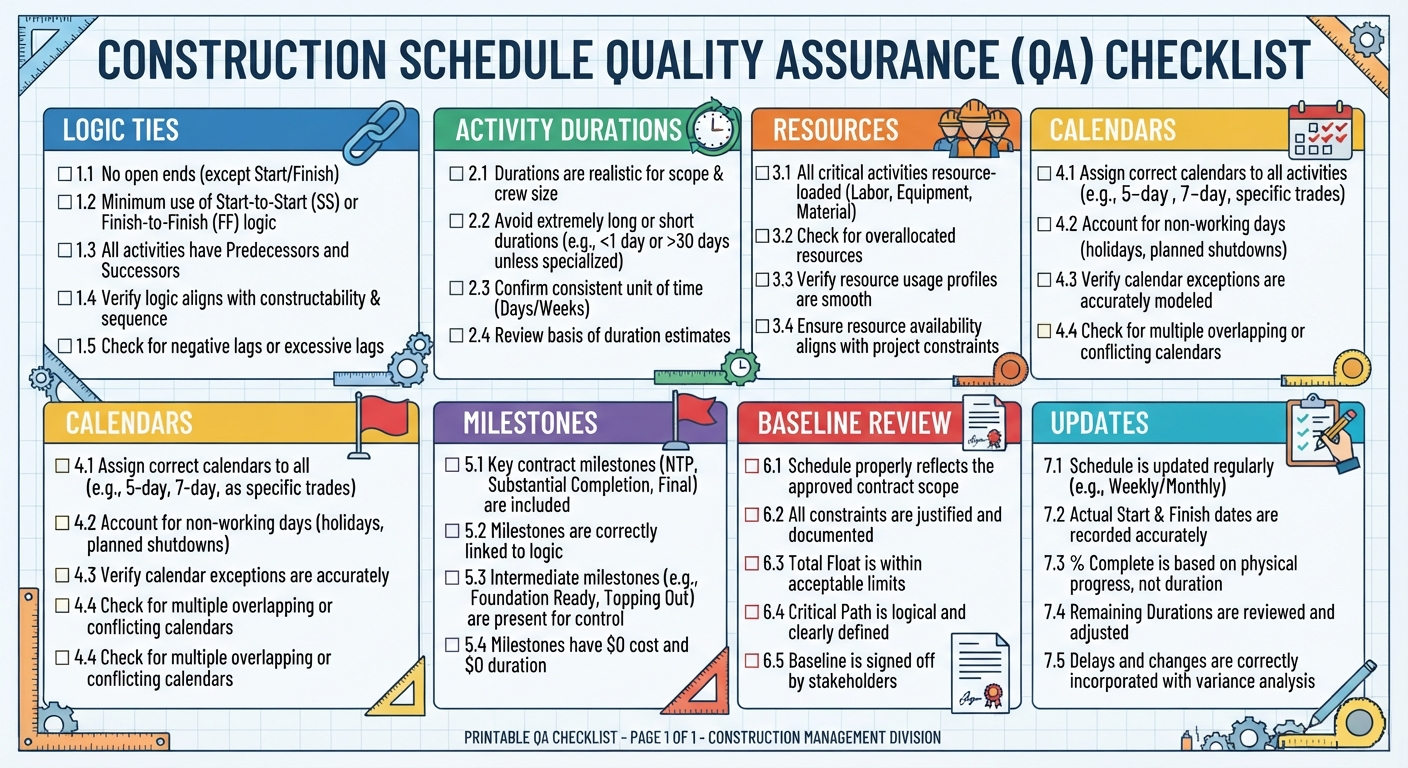
Use the following checklist to review a construction schedule checklist before submitting it for approval or using it to monitor project performance.
Construction Schedule Checklist Item |
| Project scope and contract information are accurate |
| All work packages are identified in the WBS |
| Construction activities are clearly defined |
| Activity durations are realistic |
| Start and finish dates are assigned |
| Dependencies reflect the actual work sequence |
| Contractual and internal milestones are included |
| Labor, equipment, and material requirements are considered |
| Procurement and delivery lead times are included |
| Permits, submittals, and inspections are scheduled |
| Critical path and float have been reviewed |
| Project calendars and working hours are accurate |
| Baseline schedule has been reviewed and approved |
| Progress reporting and update frequency are established |
| Risks and contingency allowances are documented |
| Testing, punch list, and closeout activities are included |
A completed construction schedule checklist does not automatically mean that a schedule is accurate. The project team should also verify the logic, durations, assumptions, and resource requirements against the drawings, specifications, contract documents, and actual construction conditions.
When Should a Construction Schedule Be Reviewed?
A construction schedule should be reviewed during preconstruction, before baseline approval, during regular progress meetings, after approved scope changes, and whenever significant delays or site conditions affect planned activities.
The review should focus on whether the schedule still reflects the approved scope, actual progress, resource availability, and remaining work.
For complex projects, a professional scheduling review can help identify missing activities, incorrect dependencies, unrealistic durations, and potential conflicts between trades before they create larger coordination problems.
Frequently Asked Questions
1. What should be included in a construction schedule checklist?
A construction schedule checklist should include project scope, work activities, WBS, task durations, start and finish dates, dependencies, milestones, labor and equipment requirements, procurement, permits, inspections, critical path, baseline approval, and progress updates.
2. What are the five main components of a construction schedule?
Five fundamental components are:
- Work activities and project scope
- Activity durations and dates
- Dependencies and construction sequence
- Milestones and project deadlines
- Resources and progress tracking
A complete schedule also needs procurement, approvals, risk planning, and closeout activities.
3. What is a baseline construction schedule?
A baseline construction schedule is the approved project timeline used as a reference for measuring actual progress. It includes planned activities, durations, dependencies, and milestones and provides a basis for evaluating schedule changes and delays.
4. How often should a construction schedule be updated?
The update frequency depends on contract requirements and project complexity. Many projects use weekly or monthly updates. Each update should reflect actual progress, remaining durations, revised forecasts, and changes affecting the critical path.
5. What is the difference between a construction schedule and a lookahead schedule?
A construction schedule presents the overall project timeline, including major activities and contractual milestones. A lookahead schedule focuses on upcoming work, usually over a shorter period, to coordinate crews, materials, equipment, and site readiness.
6. Which software is used for construction scheduling?
Common construction scheduling tools include Primavera P6, Microsoft Project, and other project management platforms. The appropriate software depends on project size, scheduling requirements, reporting needs, and team experience.
7. Who is responsible for preparing a construction schedule?
The general contractor or construction manager typically coordinates the construction schedule. A project scheduler may develop and maintain it, working with subcontractors, suppliers, consultants, and the project owner to verify activity durations, dependencies, and milestones.
Bottom Line
A reliable construction schedule connects project activities, resources, procurement, approvals, and milestones into a coordinated timeline. Using a Construction Schedule checklist helps project teams review these elements against approved drawings, specifications, and contract requirements, identify scheduling gaps, and monitor progress throughout construction.
Engineering Geni provides professional construction scheduling services for contractors, builders, and construction teams across the USA. Whether you need support with a new project schedule or an existing schedule review, our team can help organize project activities and scheduling requirements.
Need professional construction scheduling support? Share your project scope and drawings with Engineering Geni for a review and quote.