The Blueprint for Success: What You Need to Know About Construction Estimating Services
Bad ideas are not the reason why construction projects fail. They are the bad numbers. An accurate estimate is the very foundation on which everything else is built, irrespective of how stunning the design is or how proficient the workers are. That is the reason why construction estimating has become such a crucial factor in the building industry and it is a major factor that molds the project owners, architects, general contractors, and Developers to see the exact cost of a project even before the first brick is laid.
A comprehensive estimate determines the course of everything that follows, such as the budgets, materials, timelines, and labor. In the current competitive U.S. construction market, even a minor error in estimating can lead to a loss of thousands of dollars. That is why the knowledge of construction estimating is not only a matter of convenience but a necessity.
We shall break down everything you must know below, using simple language that even a novice can grasp, step-by-step.
Introduction: Why a Detailed Estimate Is the Most Important Document in Construction
Before any construction project begins, one question matters most: “How much will this cost?” This is where construction estimating services come in. These services make the understanding of a complicated process much more straightforward. A comprehensive estimate breaks down each cost component such as materials, labor, equipment, overhead, and possible risks. It provides a lucid trail for all involved parties, contractors, clients, investors, and builders.
What is the reason for the significance of this document?
- It shields the budget from surprises
- It helps in the elimination of delays
- It is a factor that strengthens the relationship between the client and the contractor
- It makes sure that the project is financially safe
- It limits the budget so that the team does not overspend
A powerful estimate acts as a cover. It prevents the whole project from becoming a financial disaster. Hence, construction estimating is viewed as the groundwork of the whole building process.
Types of Estimates: Conceptual, Detailed, and Preliminary
Not all construction cost estimating are equivalent; indeed, there are several kinds of estimates used in various phases of the project, and each of them makes the team’s understanding of cost expectations more precise.
1: Conceptual Estimate
The cost of this type is determined very early in the project. sometimes even before the designs are ready. It provides a very rough estimate of the price taking into account the past projects and randomly made assumptions. Although not very precise, conceptual estimating aids owners in making the decision to proceed or not.
2: Preliminary Estimate
Preliminary estimation is one step more accurate than the previous one. It analyzes early drawings and the project’s area with a measuring tool, sometimes even the factors involved in the project are calculated. During this stage, the number gets more and more precise but they still cannot be regarded as final.
3: Detailed Estimate
The most accurate type of estimating is the one that is highly detailed. It accounts for every item such as the precise material, the amount of labor hours, a complete list of materials required, and the costs of equipment. This type of construction estimating is very helpful in deciding when to buy what, how long the job will take, and what the contract terms will be.
Each of them has a specific reason for being used. If they are applied in the right way, the construction estimating process would be as easy and trustworthy as a process rather than a game of chance.
Each type has its own purpose. When used correctly, they make construction estimating a smooth and reliable process instead of a guessing game.
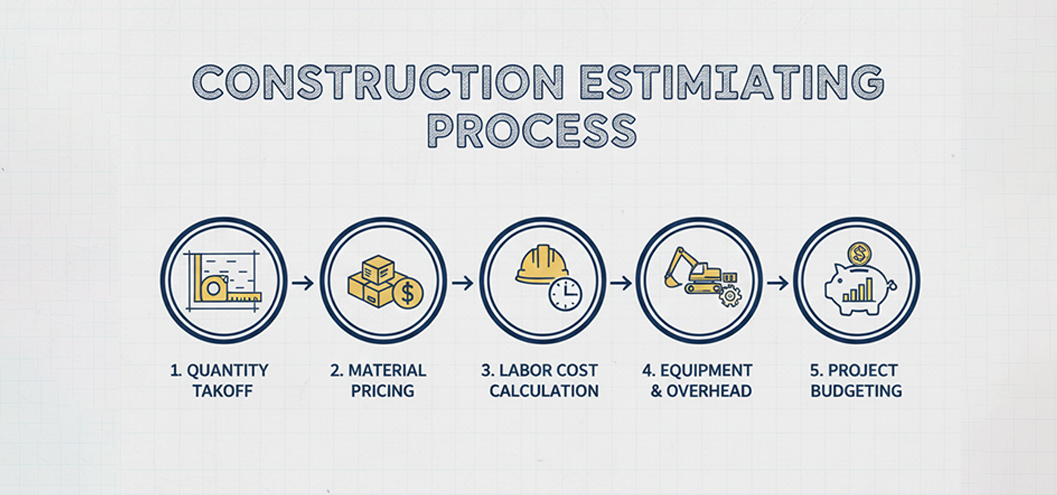
The Estimating Process: A Step-by-Step Guide to How It’s Done
The estimating process is like creating a financial blueprint. Just like a blueprint designer carefully draws every wall and corner, an estimator evaluates every small detail to make sure the numbers are right.
Here’s how it works:
Step 1: Reviewing Plans and Documents
Estimators look into architectural and structural drawings. They also check for specifications, timelines, materials, and design requirements.
Step 2: Quantity Takeoff
This is the most important step among all. The estimator lists and measures all the materials required for construction—the cement bags, wood panels, pipes, wiring, tiles, windows, and more.
Step 3: Pricing Materials and Labor
Then, the estimator finds out the latest U.S. market prices. Prices vary frequently, thus precision is important.
Step 4: Checking Equipment and Overhead Costs
It encompasses the cost of machines, tools, safety equipment, transport, office work, permits, and insurance.
Step 5: Adding Profit Margin
A contractor usually applies a mark-up price to their services, thus covering the cost and earning a profit.
Step 6: Reviewing and Finalizing
The estimator revisits the process one more time checking for any mistake before the estimate is made available to the client. A single line item missed can lead to unpredicted losses.
A reliable estimator goes through every step with utmost meticulousness. This is the very reason that construction estimating is reliable and trustworthy.
Common Mistakes to Avoid: Why an Amateur Estimate Can Be Disastrous
The estimating phase is often where many construction mistakes arise. This is usually the case when a person with little or no experience in handling numbers is responsible for the calculations. If a project lacks a professional estimate, it can lead to chaos very fast.
The most common mistakes are the following ones:
1: Not Considering Variations in Material Prices
The prices of concrete, steel, wood, and electrical materials are in constant flux. A budget based on an old estimate can be a disaster.
2: Wrong Quantity Estimates
When the estimator miscounts the number of tiles or panels, the project might suffer from either a shortage or a surplus.
3: Lack of Labor Complexity Consideration
Labor is not all of one kind. Skilled work is more expensive. Inexperienced workers often underestimate the labor hours and rates.
4: Not Taking into Account Permits and Fees
Ignoring the local building permits, inspection fees, and taxes can create a substantial financial gap.
5: No Risk Factor Considered
A good house design in blueprints includes backups. It is necessary for the estimators to include the contingency percentage for the unforeseen problems in their calculations.
These mistakes are a wake-up call for serious and professional construction estimating methods. A professional construction estimator saves the company from thousands or even millions, the latter which can be due to errors in costing, to name a few.
Conclusion: A Reliable Estimate Is Your Project’s First Line of Defense
The construction estimate is the real foundation of a construction project. The safest and the most efficient manner of getting the job done is only possible if the right numbers come into play even if the best team is on the project. That is why, among other reasons, construction estimators are viewed as the guardians of the project. The quality of their work guarantees adequate planning, control of the budget, and smooth execution.
Each stage of the construction process is backed by a trustworthy estimate: it guarantees the success of planning, budgeting, purchasing, scheduling, and safety. It not only prevents financial disasters but also ensures everyone working on the project communicates effectively.
In the U.S. construction industry, which is moving at a fast pace, using experienced professionals for construction estimating is not only a smart move but also a necessity for success.
FAQs:
Q: What is construction estimating?
Ans: Construction estimating is the process of calculating the total cost of a construction project, including labor, materials, equipment, and overhead.
Q: Why are construction estimating services important?
Ans: They help prevent budget overrun, delays, and financial risks. They also ensure transparency between contractors and clients.
Q: How accurate are detailed estimates?
Ans: The other types of estimates are less accurate than detailed estimates and come very close to the final project costs sometimes.
Q: Who prepares the estimates?
Ans: They are made by professional construction estimators or estimating firms that rely on industry data, software, and their skills.
Q: What happens if a project starts without an estimate?
Ans: It might suffer from cost overruns, delays, material shortages, and financial losses.